What Is IDV in Car Insurance? Meaning, Calculation & How to Choose the Right IDV
Direct answer: IDV (Insured’s Declared Value) is the maximum amount your insurer will pay you if your car is stolen or damaged beyond repair. It’s basically your car’s current market value after depreciation. It directly decides your car insurance premium and how much you can get back if you ever make a total loss or theft claim.
Key Takeaways
- IDV stands for Insured Declared Value. It is treated as the sum insured for your car insurance policy.
- Total IDV simply means the full insured value of your car for that policy year. It is not a separate cover or an add-on.
- Your car’s IDV is calculated using its showroom price minus depreciation based on its age.
- A higher IDV usually means a higher insurance premium, but it also increases the amount you can receive if your car is stolen or declared a total loss.
- You can review and update your IDV when you renew your policy each year.
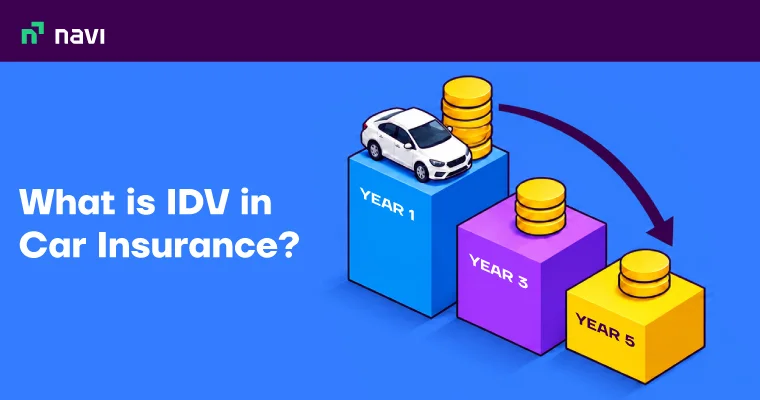
- Since your car depreciates over time, its IDV value also reduces with age.
What Is Insured Declared Value?
IDV, or Insured Declared Value, is the amount your insurance company agrees to pay you if your car is stolen or damaged beyond repair. It’s fixed at the start of every policy year and is treated as the “Sum Insured” for that year.
Sum insured is the maximum amount your insurance company will pay if you make a valid claim during the policy period.
How Is IDV for Your Car Calculated?
IDV can easily be calculated using this formula:
IDV = Manufacturer’s listed selling price − Depreciation (based on the car’s age)
If you’ve installed accessories in your car after purchase, such as a music system, their value after depreciation is also added to the IDV.
Then the formula becomes:
IDV = (Selling price − Depreciation) + (Accessory cost − Accessory depreciation)
Here’s the standard car depreciation rate used to calculate IDV:
| Age of the Car | % Depreciation for IDV |
| Not exceeding 6 months | 5% |
| 6 months to 1 year | 15% |
| 1 to 2 years | 20% |
| 2 to 3 years | 30% |
| 3 to 4 years | 40% |
| 4 to 5 years | 50% |
| Beyond 5 years / discontinued models | Decided mutually between you and the insurer |
Example
Let’s take a simple example.
Suppose your car’s ex-showroom price is ₹8,00,000, and it is 2 years old. Based on the depreciation table above, a 20% depreciation rate applies to your car.
IDV = ₹8,00,000 − 20% of ₹8,00,000
= ₹8,00,000 − ₹1,60,000 = ₹6,40,000
This means your car’s IDV is ₹6,40,000. Now, if your car is stolen or damaged beyond repair during the policy period, this is the maximum amount your insurer may pay, subject to your policy’s terms and conditions.
What’s the Difference between IDV and Sum Insured?
Many people get confused between IDV and Sum Insured, but in car insurance, they mean the same thing.
Your IDV is the Sum Insured for your car insurance policy. It is the maximum amount your insurer agrees to pay if your car is stolen or damaged beyond repair during the policy period.
This confusion usually comes from other types of insurance, such as health or home insurance. In those policies, you can choose your Sum Insured based on the coverage you want. However, in car insurance, the Sum Insured is based on your car’s IDV, which is calculated using its value and depreciation.
So, you don’t choose a separate Sum Insured. Your car’s IDV becomes the Sum Insured for your policy.
| Feature | IDV (Car Insurance) | Sum Insured (General) |
| How it’s decided | Calculated using car price + depreciation | Often chosen by the policyholder within a range |
| What it represents | Maximum payout for total loss/theft | Maximum policy payout limit |
| Changes over time | Decreases every year with car age | May stay flexible depending on the policy type |
What Factors Affect Your Car’s IDV?
Your car’s IDV depends on a lot of factors that affect its market value.
1. Car Age: The older your car is, the lower its market value. This is because depreciation increases with age, which reduces the IDV.
2. Car Type: The type of car also affects its IDV. For example, an SUV will usually have a higher IDV than a hatchback because their market values are different.
3. Make and Model: Different makes and models have different market values. Even two cars in the same category can have different IDVs depending on the brand, variant, and features.
4. Ex-Showroom Price: Your car’s ex-showroom price is the starting point for calculating its IDV. Cars with a higher ex-showroom price usually have a higher IDV.
5. Accessories: Accessories installed after you buy the car, such as a music system, may also be included in the IDV after depreciation if they are covered by your policy.
6. Place of Registration: The ex-showroom price of the same car can vary slightly across cities. This can lead to small differences in the IDV.
7. Car Condition: The overall condition of your car also matters. Factors such as wear and tear, mileage, and approved modifications can affect its market value and, in turn, its IDV.
Higher IDV vs Lower IDV: Which One Should You Choose?
Choosing a higher or lower IDV depends on how you want to balance your insurance premium and potential claim amount.
| Feature | Lower IDV | Higher IDV |
| Premium | Lower | Higher |
| Payout on total loss/theft | Lower | Higher |
| Best suited for | Older cars, budget-conscious buyers | Newer or premium cars, owners who want maximum protection |
| Main risk | Being under-compensated if the car is declared a total loss | Paying a higher premium than necessary |
When Should You Buy a Car Insurance Policy with a Lower IDV?
A lower IDV works well if:
- Your car is a few years old, and its market value has dropped a lot.
- You’re looking to reduce your premium and are comfortable with a smaller payout in case of theft or total loss.
- You don’t plan to keep the car for much longer.
When Should You Buy a Car Insurance Policy with a Higher IDV?
A higher IDV works well if:
- Your car is new.
- You want a higher payout if your car is stolen or declared a total loss.
- You’re comfortable paying a higher premium for better financial protection.
- You want the IDV to be closer to your car’s current market value.
Can You Increase or Decrease IDV at Renewal?
Yes, you can increase or decrease your car’s IDV at renewal, but only within the range allowed by your insurer.
Your IDV is usually recalculated every year based on your car’s age and depreciation, so it naturally reduces over time.
However, if you feel the suggested IDV does not match your car’s current value, you may be able to adjust it during renewal within the insurer’s permitted range.
Many insurers allow changes of around ± 15% of the recommended IDV, depending on their policy rules.
You also have to keep in mind that increasing your IDV increases your premium, and lowering it may reduce your premium but also reduces your claim payout in case of theft or total loss.
Hence, it is best to choose an IDV that is close to your car’s actual depreciated value.
How Does IDV Affect Your Car Insurance Claim?
IDV matters in car insurance because it decides the maximum amount your insurer may pay if your car is stolen or declared a total loss. It acts as the insured value of your car for that policy year.
Theft Claims: If your car is stolen and the police confirm that it cannot be found, your insurer settles the claim based on the IDV mentioned in your policy document. This means the payout you get is based on the car’s insured value at the time of the claim.
Total Loss and Constructive Total Loss (CTL): If your car is damaged so badly that repairing it is not practical at all, then it may be declared a total loss. In such cases, your insurer pays the IDV mentioned in your policy instead of the repair cost.
A car is considered a Constructive Total Loss (CTL) when the cost of repairs exceeds 75% of the car’s IDV, as mentioned in the policy terms.
For example, if your car’s IDV is ₹6 lakh and the repair cost goes above ₹4.5 lakh, it may be treated as a CTL.
Once your IDV is fixed at the start of the policy year, it remains unchanged for that policy period. It does not reduce further during the year for total loss or CTL claims, even though your car continues to age.
Common IDV Mistakes to Avoid
1. Choosing a Lower IDV to Pay a Lower Premium: A lower IDV can reduce your insurance premium, but it also reduces the amount you receive if your car is stolen or declared a total loss. Since the claim payout is based on your IDV, choosing a very low IDV may leave you under-compensated.
2. Choosing a Higher IDV Without Understanding the Cost: A higher IDV may get you a higher claim payout, but it also increases your premium. Choosing an IDV much higher than your car’s actual value may mean paying more without getting additional benefits.
3. Confusing IDV With Your Car’s Resale Value: IDV is not the same as resale value. Your car’s resale value depends on market demand, condition, mileage, and buyer negotiation. IDV, on the other hand, is calculated using a standard insurance formula based on the car’s value and depreciation.
4. Not Reviewing Your IDV During Policy Renewal: As your car gets older, its value decreases due to depreciation, and so does its IDV. Reviewing your IDV at renewal helps make sure it matches your car’s current value.
5. Not Adding Accessories to Your IDV: If you install accessories such as a music system after purchasing your car, make sure you declare them to your insurer. If they are not included, they may not be covered during a claim.
Conclusion
IDV is simply your car’s declared value. It decides your premium and the payout you may receive if your car is stolen or declared a total loss. It is calculated using your car’s value and depreciation. You must review your IDV at every renewal to make sure you have the right coverage without paying more.
Frequently Asked Questions
IDV stands for Insured’s Declared Value. It’s the amount your insurer agrees to pay if your car is stolen or declared a total loss.
Total IDV simply means the full insured value of your car for that policy year.
There’s no difference between IDV and Sum Insured for car insurance. Your car’s IDV is the Sum Insured for your policy.
You can review and adjust your IDV at each renewal, though it typically decreases as your car ages.
It depends. A higher IDV gives you a higher claim payout but comes with a higher premium. A lower IDV reduces your premium but also lowers your claim payout if your car is stolen or declared a total loss. The right choice depends on your car’s age and the level of protection you want.